Glasses become part of a haircut's outline. The top of the frames sits beside the fringe, the arms pass through the temple area and the hair behind your ears changes each time you put them on. Choosing a short cut is easier when you test those points in person. Bring the frames you wear most often and plan for the way you actually move through the day, including tucking hair back and taking your glasses off.
Wear your everyday frames to the consultation
Choose your main pair for the appointment rather than a pair you wear only occasionally. Differences in frame width, arm thickness and where the glasses sit can change how the hair rests around them. If you alternate between two very different pairs, bring both. Let the stylist see each with your hair loose and tucked back before discussing a precise temple or fringe length.
Describe your habits alongside the style you want. Do you take your glasses off for calls, swap to sunglasses outside or leave them on all day? Do you push them onto your head? These small movements can pull shorter pieces out of place. A cut that looks neat while you sit still may feel fussy if you adjust the frames frequently.
Use photographs showing glasses similar in scale to yours, but avoid treating matching frame shapes as a rule. A bold frame does not require one particular haircut, and a small frame does not forbid a full fringe. Look at the visible space around the eyes, the amount of hair at the sides and the overall shape. Decide which arrangement you like rather than following a formula about balancing round and angular features.
Explain how short you are considering at the back, sides and front separately. A pixie with long front sections, a short bob and a cropped shape with an exposed ear can all be described as short hair with glasses. They differ considerably in maintenance and in how the frame arms meet the hair. A side-view photograph helps make that distinction clear.
Check how fringe meets the top of the frames
Put your glasses on in their normal position when discussing the fringe. Notice whether the proposed ends would sit above the frames, brush the top edge or fall across them. None of those positions is automatically wrong. The question is whether you like the appearance and can tolerate the contact as the fringe moves and grows.
A straight fringe near the upper rim creates a strong horizontal arrangement. A centre opening or longer side sweep leaves a different amount of forehead visible. Compare these as separate choices, keeping the overall haircut length similar. Otherwise you may choose a shorter cut because you prefer its fringe, when a different fringe on a slightly longer shape would meet your needs.
Watch what happens at the outer corners of the frames. A front section can catch on the hinge or be pushed outward by the arm. Ask whether it should fall in front, sit above the corner or be long enough to sweep back. Use your fingers to show the preferred direction. The stylist can assess what your hair texture and growth pattern are likely to allow.
If your hair waves, judge the fringe at its dry resting length. A section pulled straight may appear clear of the frames and then lift or bend differently after drying. If your front hair naturally separates, mention how you usually manage it. A digital preview with evenly spaced strands cannot tell you whether the chosen fringe will need daily reshaping.
Allow for some growth in the decision. A fringe that sits exactly clear of the rim on cutting day may touch it later. Ask how that length can be worn between appointments and which adjustment would keep it comfortable. If you already dislike hair near the top of the lenses, explain that boundary before choosing the shortest front section.
Leave room at the temples and behind the ears
The temple area is where the cut and frame arms interact most directly. Hair may sit above an arm, fall over it or tuck beneath it near the ear. Look at what happens naturally when you put the glasses on, without rearranging each strand. Tell the stylist whether you want a visible side piece or a cleaner, more exposed area.
With a short bob, test whether the front reaches comfortably behind the ears. A length that almost reaches can repeatedly spring forward or catch on the frame arm. You may prefer to leave it loose, keep it longer or choose a shorter side section intentionally. Ask to see the difference rather than assuming every short bob can be tucked in the same way.
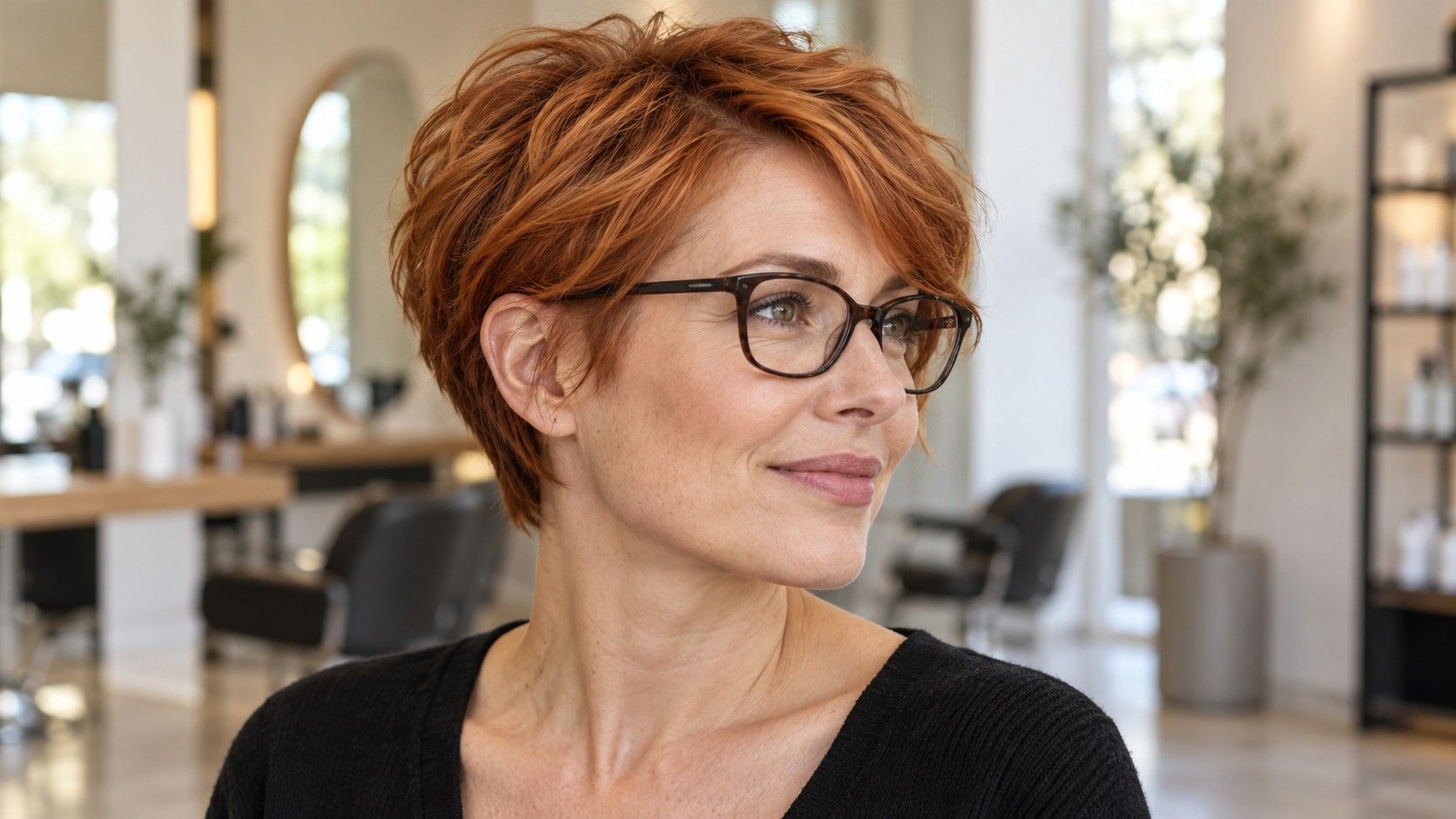
For a pixie or crop, check the sideburn area in profile. Decide whether you want a pointed piece, a soft longer section or more of the ear visible. The glasses create another line there, so a few millimetres can change the appearance. The stylist should show you how the proposed shape meets the arm and how it will look when you take the frames off.
Check behind the ears with your normal pair in place. A mass of tucked hair can be uncomfortable or simply look fuller than you want. Hair density matters here as well as strand thickness: a fine strand does not necessarily mean there is little hair to tuck. Ask how the cut can address local bulk without making the visible perimeter lighter than you prefer.
If your glasses themselves feel tight, slip or sit unevenly, haircut planning cannot settle their fit. Have the frames assessed through the appropriate eyewear service. At the salon, focus on how the hair lies around a pair that sits as intended. That keeps the discussion precise and avoids removing extra hair to compensate for a frame problem.
Compare side views as well as a front portrait
A front portrait tells only part of the story. The frame arms extend backward, while the crown and nape determine the haircut's side silhouette. Look at references from the side to see where the volume sits and how much length remains behind the ears. A style that seems compact from the front can have a fuller or more graduated back.
Compare the perimeter with the frames in place. In a chin-length bob, does the bottom line end near the lower edge of the frame or well below it? In a crop, do the top layers create height you enjoy, or do you prefer the shape closer to the head? There is no required ratio. Use those visible landmarks to explain your taste.
| Area to check | Try this movement | Decision it helps settle |
|---|---|---|
| Fringe and upper rim | Look down, then return to your usual posture | Whether loose ends fall onto the frames |
| Front corners | Remove and replace the glasses normally | Whether side pieces catch or need repositioning |
| Behind the ears | Tuck the hair back with the glasses on | Whether the length and amount of hair feel workable |
| Side outline | Turn in profile with the hair resting naturally | How crown, ear and nape shapes sit beside the frame arms |
Take a natural front and side photograph if you use a hairstyle preview. Keep the same frames in each comparison and check that the result has not changed their size, position or shape. An altered frame can make the haircut look more balanced for reasons unrelated to your choice. Treat a preview as a way to discuss the silhouette, with the physical fit checked in person.
Choose a finish that survives taking glasses on and off
Think about the amount of resetting you are happy to do. A neatly sculpted side sweep may need attention after the frame arms pass through it. A looser finish may tolerate movement better, but it still depends on the cut and texture. Ask the stylist to show you how to restore the front using a simple movement rather than arranging it only for the mirror check.
Discuss the shortest layer and your usual parting. If you change the parting, a section that once fell away from the frame may move into it. If you use no heat at home, ask how the front and crown are expected to dry. A polished salon finish can be enjoyable while remaining a poor example of your daily routine.
Before leaving, put the glasses on and take them off a few times in your ordinary way. Tuck the sides, look down and turn your head. Check the cut without the frames too, particularly if you switch to contact lenses for part of the week. Mention persistent catching or a section that falls into an unwanted position while the stylist can assess it.
Record the useful details for your next appointment: where the fringe first became irritating, whether the sides tucked easily and which pair of glasses worked differently. When reviewing short haircuts with glasses, those observations help more than a rule about which face or frame shape “should” suit a crop. They turn a visual preference into specific lengths and movements that can be adjusted.